The 2026 Spring Art Season in New York was a whirlwind, and hands down my favorite show was the 1-54 Art Fair, the first an only international art fair (also showing in London and Marrakech) dedicated to contemporary African and Diaspora art. While the name references the 54 countries that constitute the African continent, the fair represents African artists and gallerists from around the globe.
I was lucky enough to attend opening night, and it was a blast; the most fun, most stylish, and least pretentious art party I’ve been to in ages full of great people, music, and conversation. I would be remiss to write about this experience without the cultural context of this moment. This fair opened days after the Supreme Court gutted Section 2 of the Voting Rights Act, yet everyone from the gallerists to the artists to the visitors still found so much joy, beauty, and celebration in the moment.
I don’t casually use words like “inspiring” or “uplifting”, but everyone at this show exemplified this in spades. While I’m keeping this post to my top 5 highlights (otherwise it would be a novel) EVERY gallery showing here deserves your attention – something I have NEVER said before about any art fair. Please do yourself a favor, visit the 1-54 website, and check out every artist they are showcasing – I promise you will be glad you did.
Kinky Hair Cannot Form Ponytails
Thandiwe Muriu
193 Gallery
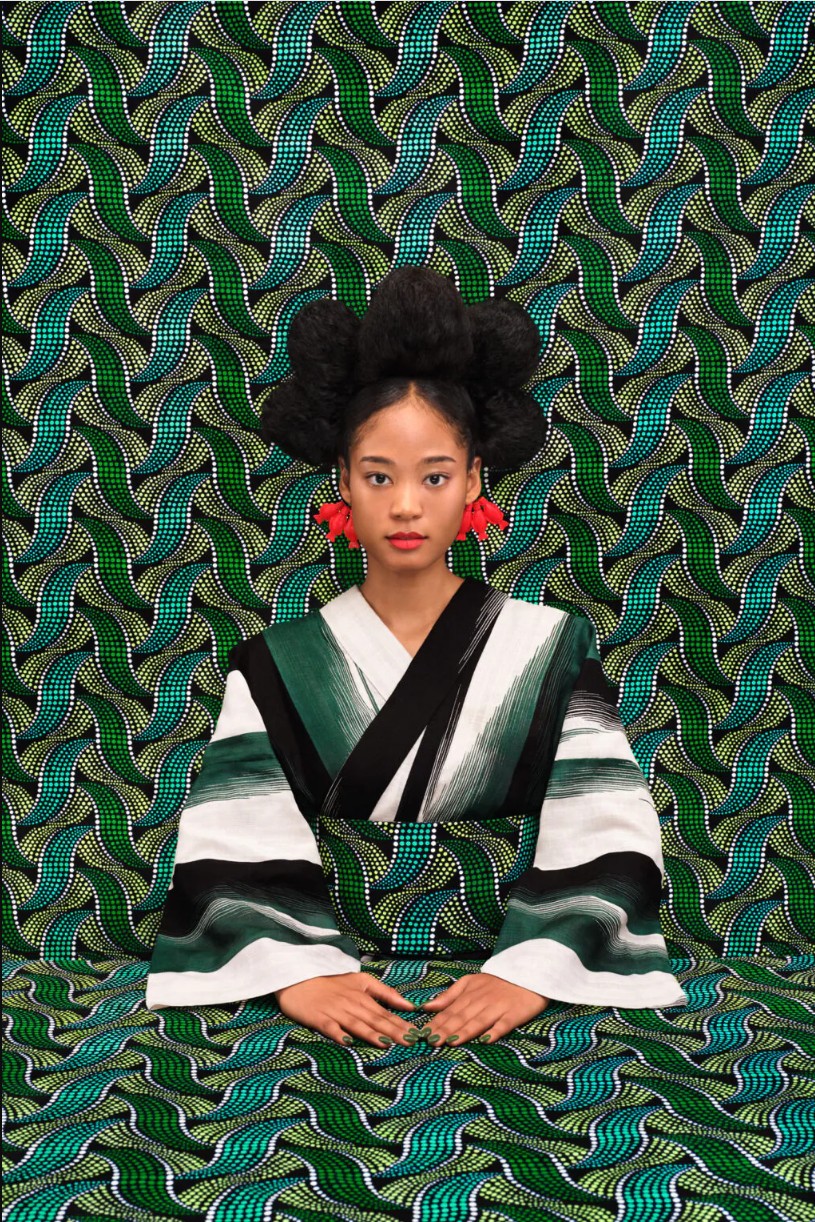
I have been a huge fan of Thandiwe Muriu’s work since I met her at the inaugural Photofair NYC in 2023. She explained to me her detailed process for her surreal and vibrant Camo Series photographs, where she begins with sourcing richly patterned fabrics (sound familiar??). She then designs the garments and backdrops for perfect pattern alignment, as well as the bold accessories (again, are we surprised I love her?), collaborating with local tailors and artisans, including the incredibly talented hair stylists, to bring her visions to life for the camera.
At 1-54, Muriu and 193 Gallery showcased 2 works from her recent residency in Kyoto, where she added a new chapter to her Camo Series, titled More Than Half, intertwining both Kenyan and Japanese textiles, motifs, and iconography to reflect on themes of belonging and community.
“Muriu shifts her focus from camouflage to coexistence, anchoring her subjects in the renowned symbol of Japanese culture, the kimono, while setting them against a widely accepted backdrop of ‘Africanness’, the wax textile. By doing so she aims to recognize the experience of Afro-Asian (Blasian) women, whose identities naturally bridge two cultures. Although multiculturalism has been promoted in recent years in Japan, judgment rooted in appearance continues to draw lines between “Japanese” and “non-Japanese.” Within this context, the duality of the Blasian identity can become a struggle. The term hāfu (half), commonly used in Japan to describe persons with one Japanese parent and one parent of another origin, reflects an assumption of incompleteness rather than wholeness. Muriu’s portraits assert that both origins form a singular, unified presence, channeling the spirit of 一如 (Ichinyo): the Buddhist term meaning “all things are fundamentally one” and expressing that what may appear divided is, at its core, already whole.”
I was really excited by these latest works and to learn how Miriu’s career has taken off since I last saw her. She has also released a book, Camo, which I just ordered and cannot recommend highly enough!
Ficus
Sophia Bounou
Blond Contemporary
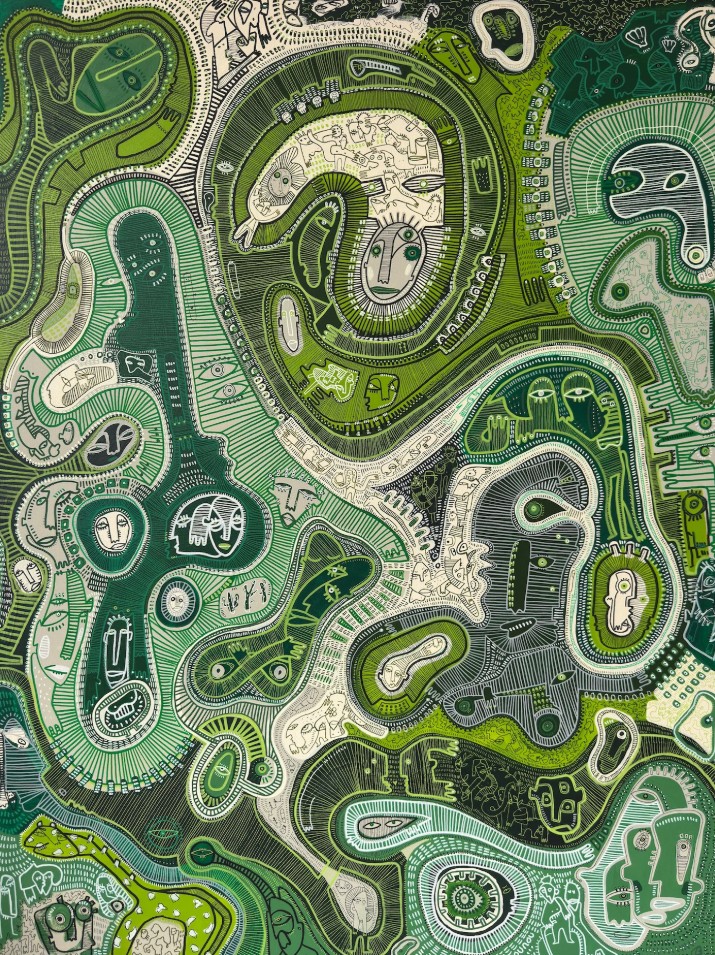
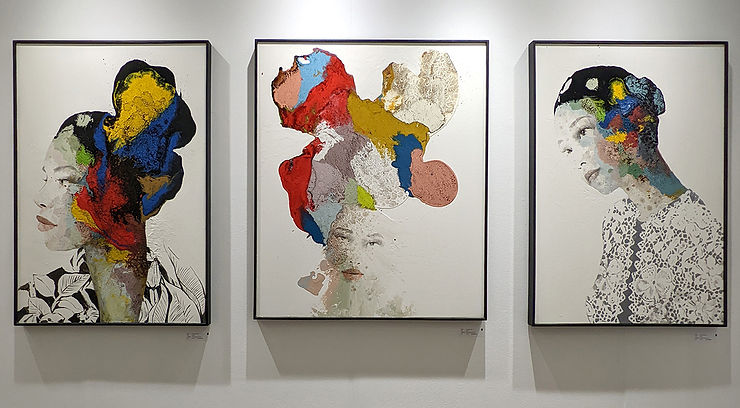
Bounou’s bold and graphically expressive monumental canvases somehow manage to evoke seeming contradictory responses – on the one hand you want to stand back and try to understand the composition as a whole, to make sense of a surreal aerial landscape – and on the other you can’t help but be drawn in so closely your nose nearly presses against the canvas exploring the minute details and stories of her imaginary worlds.
“Drawing inspiration from Pablo Picasso, Amedeo Modigliani, Jean-Michel Basquiat and Joan Miro, Sophia infuses her artworks with a rich tapestry of colors, patterns, and characters. Her works often feature a striking contrast between bold, vivid hues and the timeless elegance of black and white palettes, creating visually captivating compositions that engage the mind with recurring themes of community, identity, emotion, and rhythm.”
Residential art faces a unique challenge: it must be compelling but not overwhelming, and continue to provide surprises and discoveries months and even years after its installation. I believe Bounou’s work excels in this capacity and would be a welcome addition to nearly any collection.
The Light
Candice Tavares
Tanya Weddemire Gallery
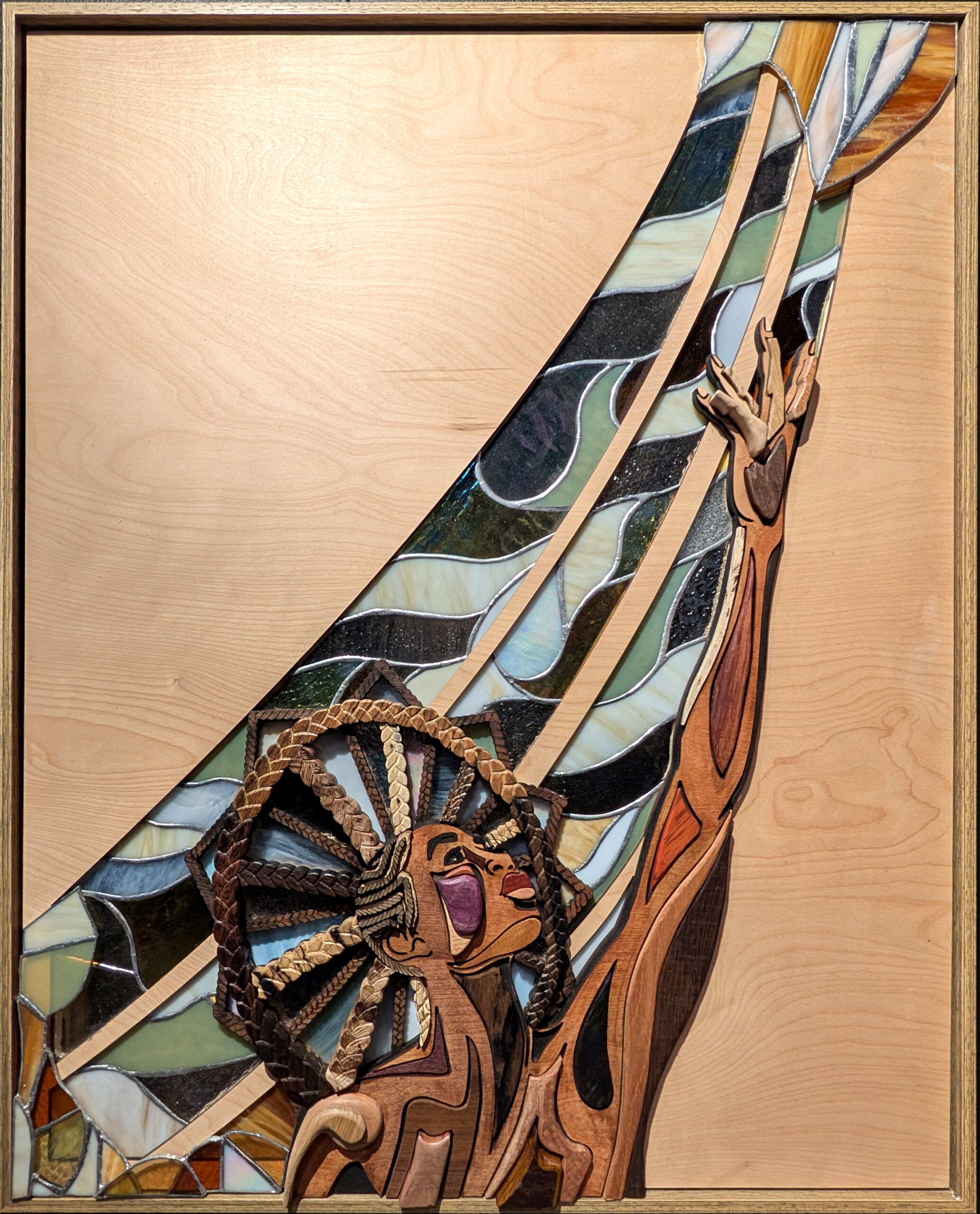
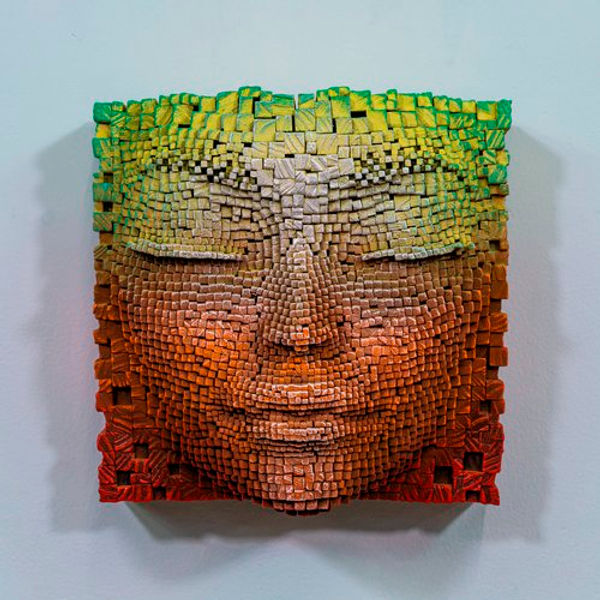
I love mixed media pieces, particularly when they really play with the contrast and capabilities of their respective materials, and Tavares’s astonishing bas-relief sculptures captivated me the moment I saw them. I also had the opportunity to speak with Tavares at length about her process, particularly with respect to material selection and juxtaposition as they relate to both real and perceived gender identity and expression.
“Tavares was introduced to woodworking as a child while helping her dad build and fix furniture in his woodshop and used that experience to develop a style of art that felt uniquely hers. Though woodworking has often been classified as a more masculine art form, she does not shy away from using it to depict images of softness and femininity. Tavares primarily focuses on using wood as a natural medium to reflect on and celebrate the natural beauty of Black women. She places heavy emphasis on including a wide range of complexions and hair textures by incorporating multiple species, stains, and techniques to create images that feel representative to women across the diaspora. She hopes that Black women and children will walk away from her work feeling seen, valued, celebrating and fortified. Reminded of their inherent beauty and value, and encouraged to love every part of themselves just as they are.”
The range of techniques she uses, from shaping to carving to etching to burning, not to mention the variety of wood species and stains is incredible. The addition of stained glass to her compositions provides the perfect foil for the wood, creating sophisticated dialogues of transparency, depth, masking and balance without sacrificing elegance or visual clarity.
I Am All In One
Reggie Khumalo
Filafriques
I have to begin by saying I was OBSESSED with every piece Filafriques showcased this year, and the Gallery owner, Carine Biley, is spectacularly knowledgeable about the detailed processes and layers of meaning behind each artist’s work. And each of her artists have almost unimaginably deep stories and methodologies…so basically she is an incredible gallerist with an impeccable eye, it was nearly impossible for me to pick favorites, so go visit her website and learn (and buy!) more about everyone she represents.
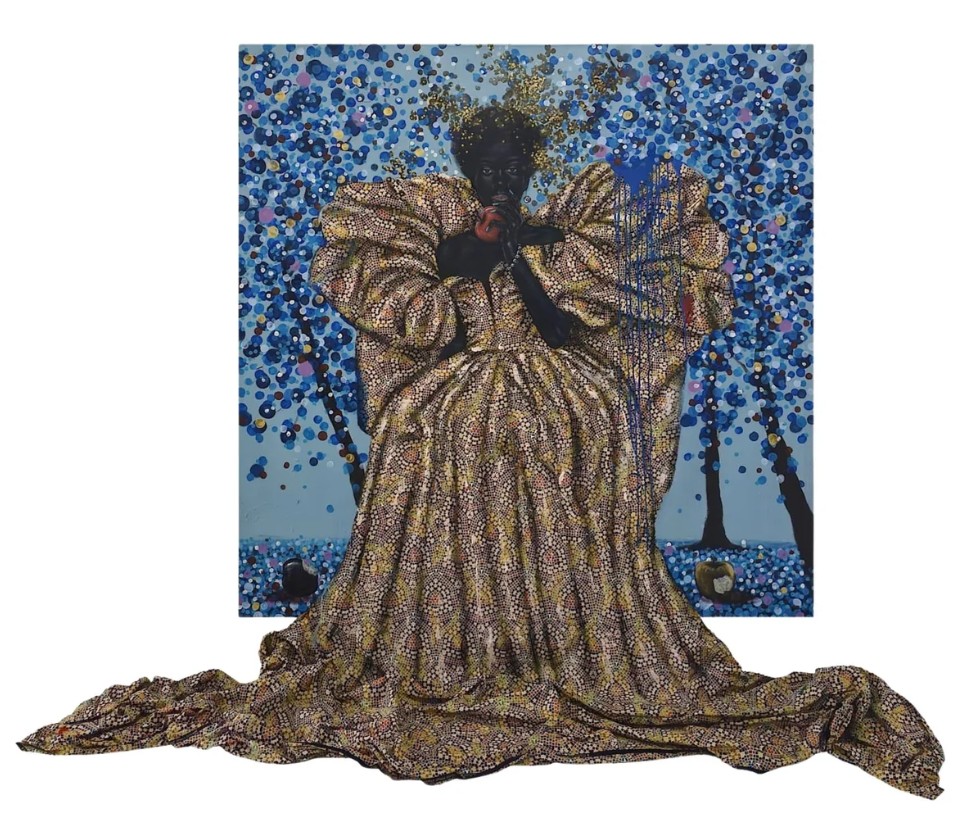
Khumalo also works with mixed media in his work, in this case fabric and paint, playing with both the legibility of his materials as well as the definition of visual space by allowing the fabric to break through the frame of the canvas. He leverages these techniques to challenge preconceived notions and assumed knowledge to access deeper levels of understanding of the human condition and community.
“Khumalo is a self taught African fine artist, humanitarian and motorbike adventurer who uses his art as a vehicle for social change. His paintings possess rich tones and bold colors that give his work a strong presence. His focus is on unearthing the innate power and humaneness within us. Reggie’s work focuses on self knowledge and empowerment and how individuals can have the power to effect change and empower their communities. He has worked across the African continent to seek out this spirit of Ubuntu. His mission is to make empathy fashionable again and bring dignity back to the African child.”
His work centers monumentally scaled African figures and traditional fabrics laden with symbolic imagery in a manner historically seen in European contexts, challenging the viewer’s subconscious ideas of art and context. Their vibrance and overwhelming generosity speak directly to his lived experience of nomadically traveling the length of Africa encountering kindness and magic around every corner.
Vela #02
Gavin Goodman
Filafriques
Yes, this is a second entry from Filafriques, but I already told you I loved everything in their booth!
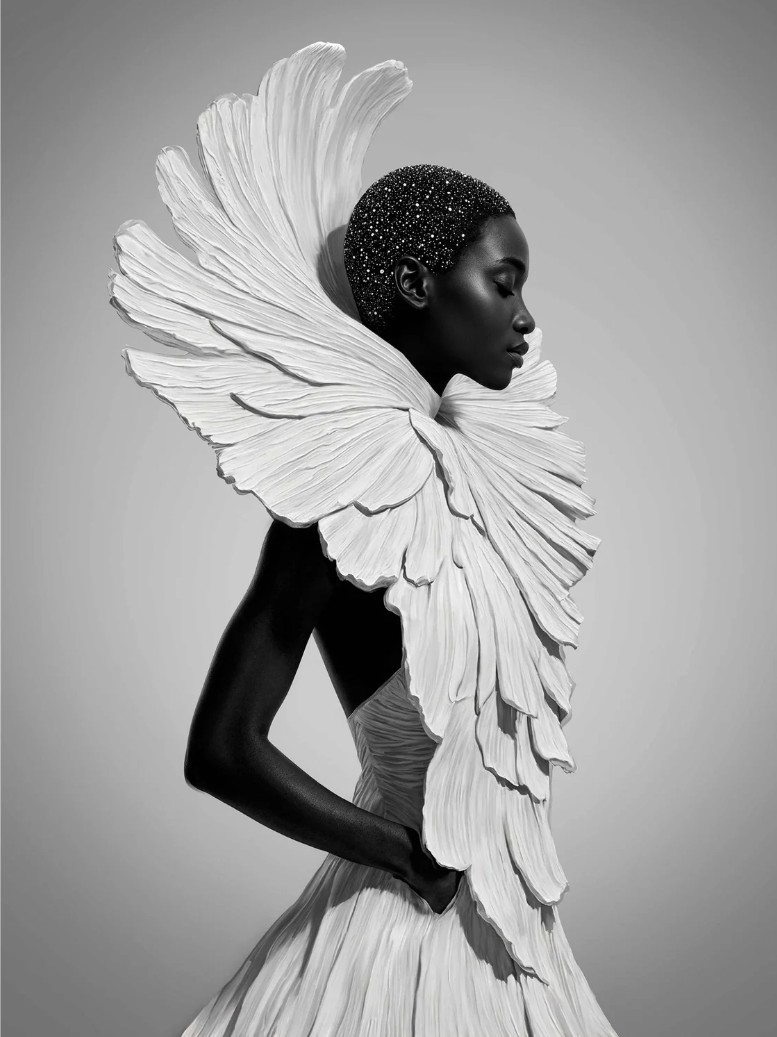
Goodman’s ethereal and regal photographs are instantly captivating. While there was only room for two “Velas” in the booth (#04 was also stunning), there are a whole series of these majestic women (not to mention the Luhlazas, Bomvus, and Ensundus…) that richly juxtapose darkness and light, hardness and softness, and mass and void.
“Goodman’s fine art photography is influenced by the traditional African culture that surrounded him throughout his upbringing. While drawing from African aesthetics, he reinterprets these influences through a modern, minimalist approach, defined by soft pastel tones, balanced compositions, and a refined, contemporary aesthetic. Vela, meaning “to appear” or “to emerge” in Xhosa and Zulu, speaks to the heart of this series. These works reflect the surfacing of beauty from tradition and the unfolding of form into a contemporary space. They don’t replicate African heritage, but rather appear as something new — interpreted through minimalist restraint and personal vision. Each hand-painted piece is a quiet unveiling, drawn from traditional garments and reimagined through a modern lens.”
Goodman’s process in the Vela Series begins with a photograph, onto which he digitally paints the models’ elaborate garments and headpieces. Each image is then run in a series of 3 photo prints and 1 canvas print, onto which Goodman hand paints over the digital additions. The results are remarkable. The palpable texture and sculptural forms speak volumes against the simple backgrounds, which seem to glow from within, giving each image an otherworldly aura and understated elegance.
As per usual, the pattern emerges when I see the highlights, and for this show there are several – rich and complex patterns, mixed media compositions, and of the course the centering of African women and their stories. There were many more terrific pieces and booths at the show, but here you have my top 5 and my top trends.
Till next time…
Madelaine